OUR PILLAR: The Demand Engine: Build It, Run Forever
Brand Drives Pipeline. Diversification Protects It. Here’s the Playbook.

by P.H. Mullen | Simply Systems LLC
“How many channels produce pipeline independently?”
That simple question, from a VC operating partner in a board meeting I’d rather forget, turns out to be the most useful diagnostic I’ve ever heard.
I answered honestly.
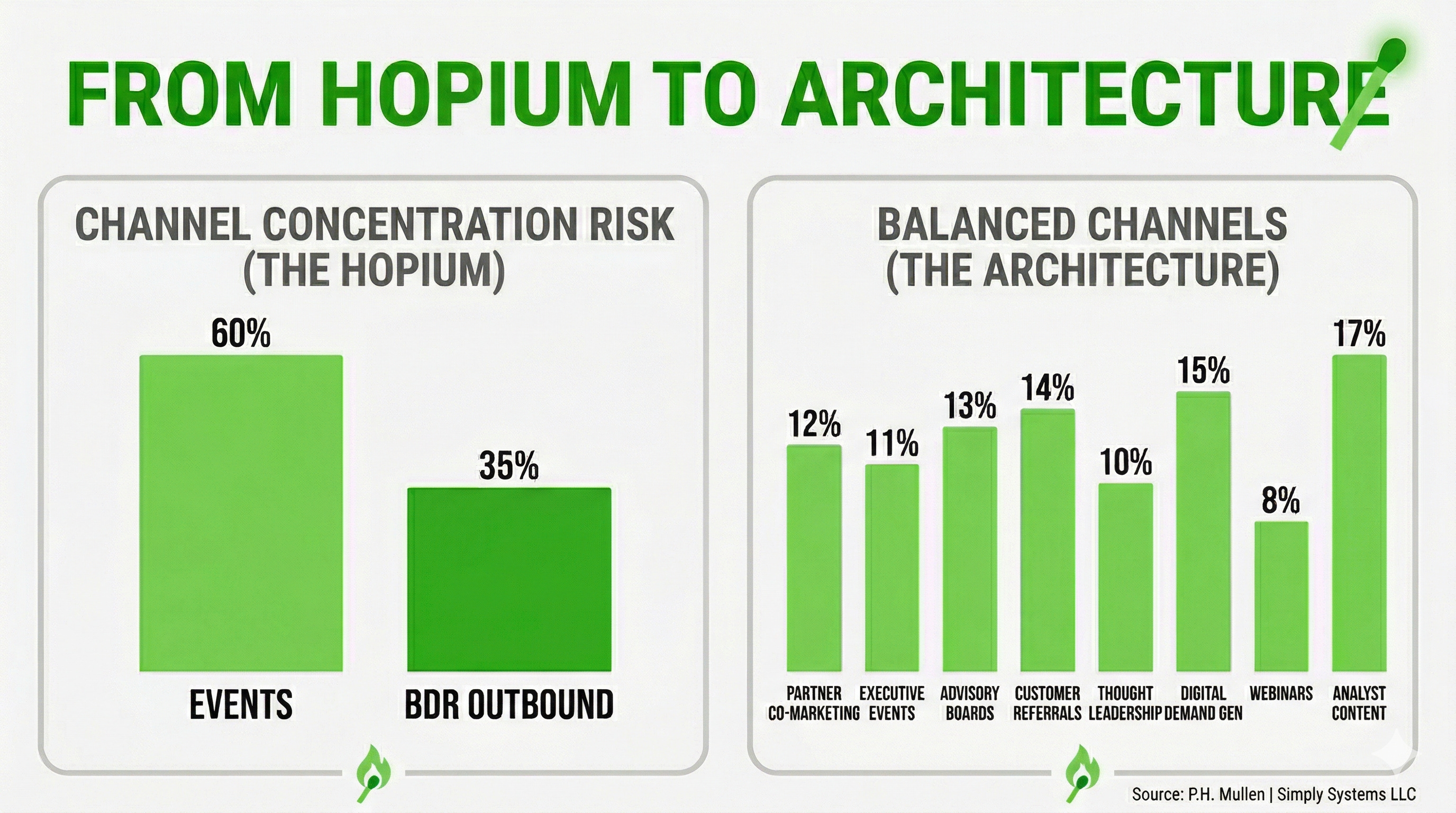
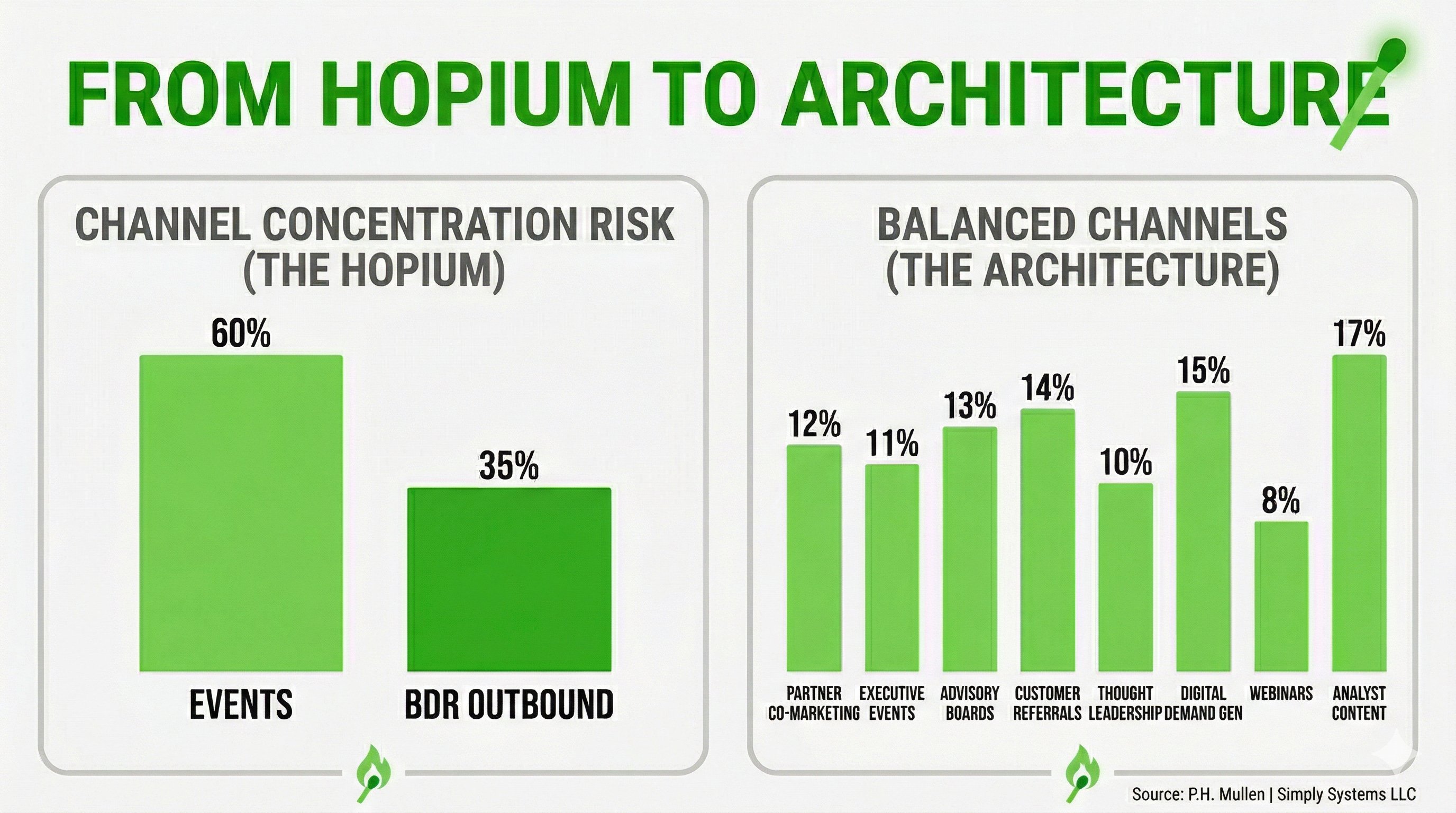
Two. We had 2 channels that deliver pipeline consistently and repeatedly. Events and BDR outbound.
Everything else was decoration on a dashboard.
The room got quiet. The kind of quiet that precedes a conversation about leadership changes.
He wasn’t asking about marketing tactics. He was asking whether the revenue engine had actual architecture or whether it was hopium.
We had hopium. Just two robust channels. And meanwhile, we had one late-stage whale deal representing 40% of the quarter. A second deal carrying 22%.
That was 62% of everything we’d promised the board resting on two New Logos and supported by two channels.
I’ve since asked that question inside every company I’ve worked with: “How many channels produce pipeline independently?”
The answer is almost always the same: fewer than four. Sometimes two. Occasionally one.
This essay is the fix. Not which channels to pick. How to build the architecture that makes channel selection a discipline instead of a guess.
(The full Growth Engine architecture, including the 3 outcomes of marketing, the Bow-Tie lifecycle, and the 2026 market forces reshaping GTM, is in The 2026 B2B Growth Engine Playbook, the pillar essay in this series. Check it out!)
Before You Pick Channels: Brand Is the Prerequisite
Most demand gen conversations start with channels. Wrong starting point. 6Sense’s Kerry Cunningham’s 2025 Buyer Experience Report surveyed 4,000+ B2B buyers globally and found that 94% of buying groups ranked their preferred vendor before making first contact—and purchased from that early favorite 77% of the time. Eighty-five percent of shortlisted vendors were already known to the buying group.
If your brand doesn’t exist in the conversation before buyers start researching, your demand channels are fighting a war they’ve already lost. Brand, which is developed through customer proof at scale, CEO visibility, category narrative, is the prerequisite condition for pipeline to function.
Winning by Design’s Growth Loops show why: customers refer during onboarding, pulling peers away from competitors before achieving full impact themselves. That loop compounds—and it’s free.
And the enterprise value case is even sharper. Play Bigger’s research, published in Harvard Business Review, shows that category leaders earn 76% of total value created in their market. That’s not a branding stat. That’s an enterprise value stat—and it’s the most neglected investment in most portfolios.
Forrester’s benchmark data shows that 61–77% of B2B revenue comes from existing customers through renewal and expansion, depending on company maturity. If that’s true—and it is—then brand and customer experience aren’t soft investments. They’re the only durable ones.
(PHM here: Brand as a potentially our strongest pipeline lever goes deep. This article only scratches the surface. A future essay in this series takes it to full operational depth, including counter-positioning, CEO visibility programs, brand-to-pipeline measurement. Coming soon!)
The Post-ABM Reckoning
ABM was supposed to fix all of this.
Target the right accounts.
Reach the right personas.
The platforms were expensive.
The dashboards were gorgeous.
For most mid-market companies, the results were mediocre.
Not because ABM theory is wrong. Because it was built on suppositions about buyer behavior that were never true; namely that a website visit means deep interest or that a whitepaper download means readiness to talk…or even that a sequence of 12 opened but unanswered emails constitutes a “relationship.”
A decade of this conditioned buyers to distrust the entire process. We earned the distrust. Every one of us who ran a “nurture” sequence that was really just a polite countdown to an SDR ambush. Sadly, we marketers built this.
The structural math confirms it doesn’t work in 2026. Enterprise B2B SaaS CAC payback runs 18–24 months at median, with bottom-quartile companies stretching past 36 months (Benchmarkit 2025 SaaS Performance Metrics Report). Cold email response rates sit below 4% (and that sounds incredibly high to me). These aren’t temporary dips. They’re structural.
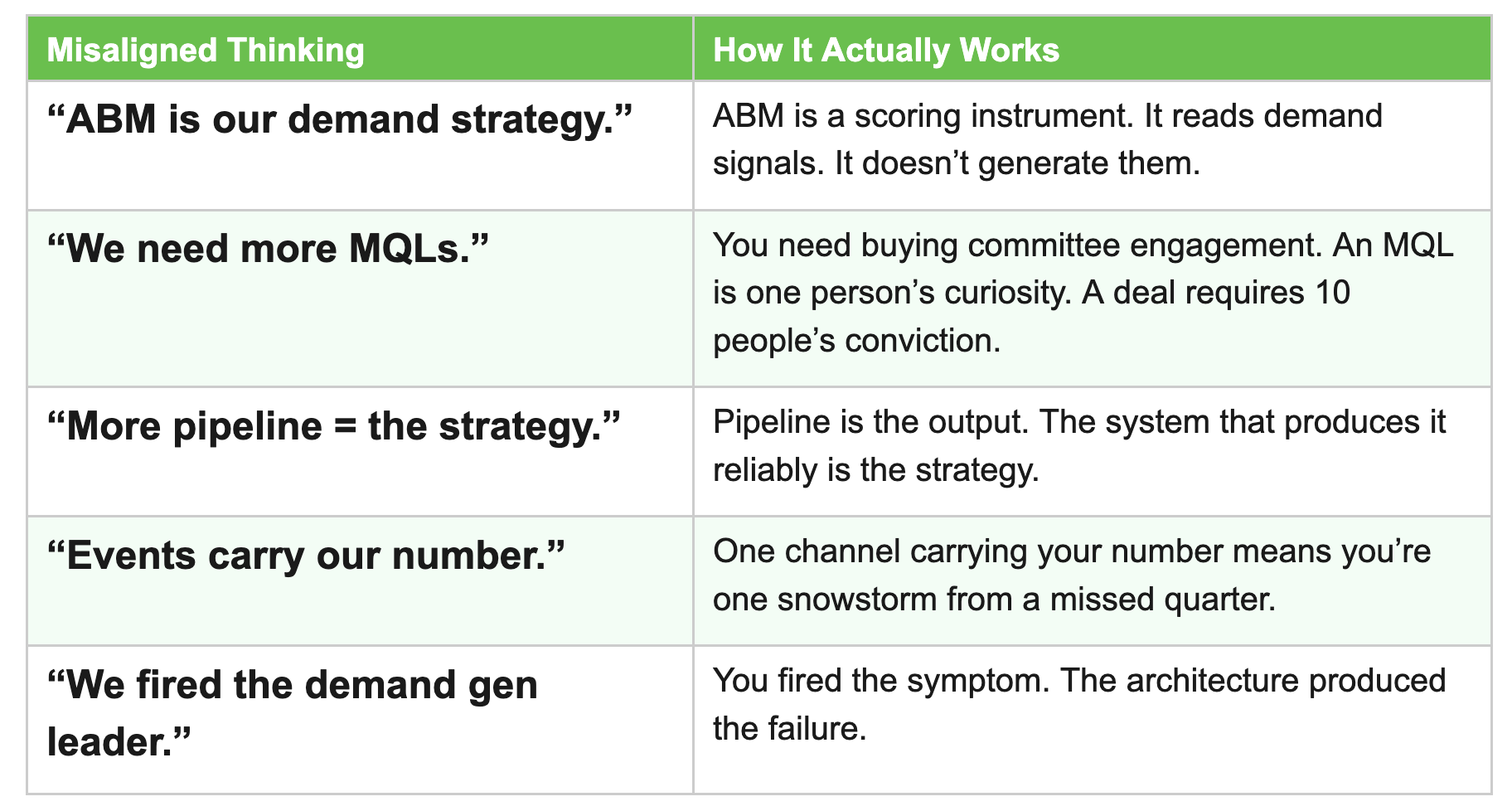
ABM isn’t dead. But it’s not your go-to, fail-safe strategy anymore. It never was. It’s a foundational instrument inside a broader architecture.
In 2024, my friends at GTM Partners, Pavilion, and Winning by Design created the GTM Consortium and produced GTM Partners Manifesto:
A Channel is a single-team activity measured on top-of-funnel leads.
A Motion is cross-functional, revenue-attached, and spans the full buyer journey.
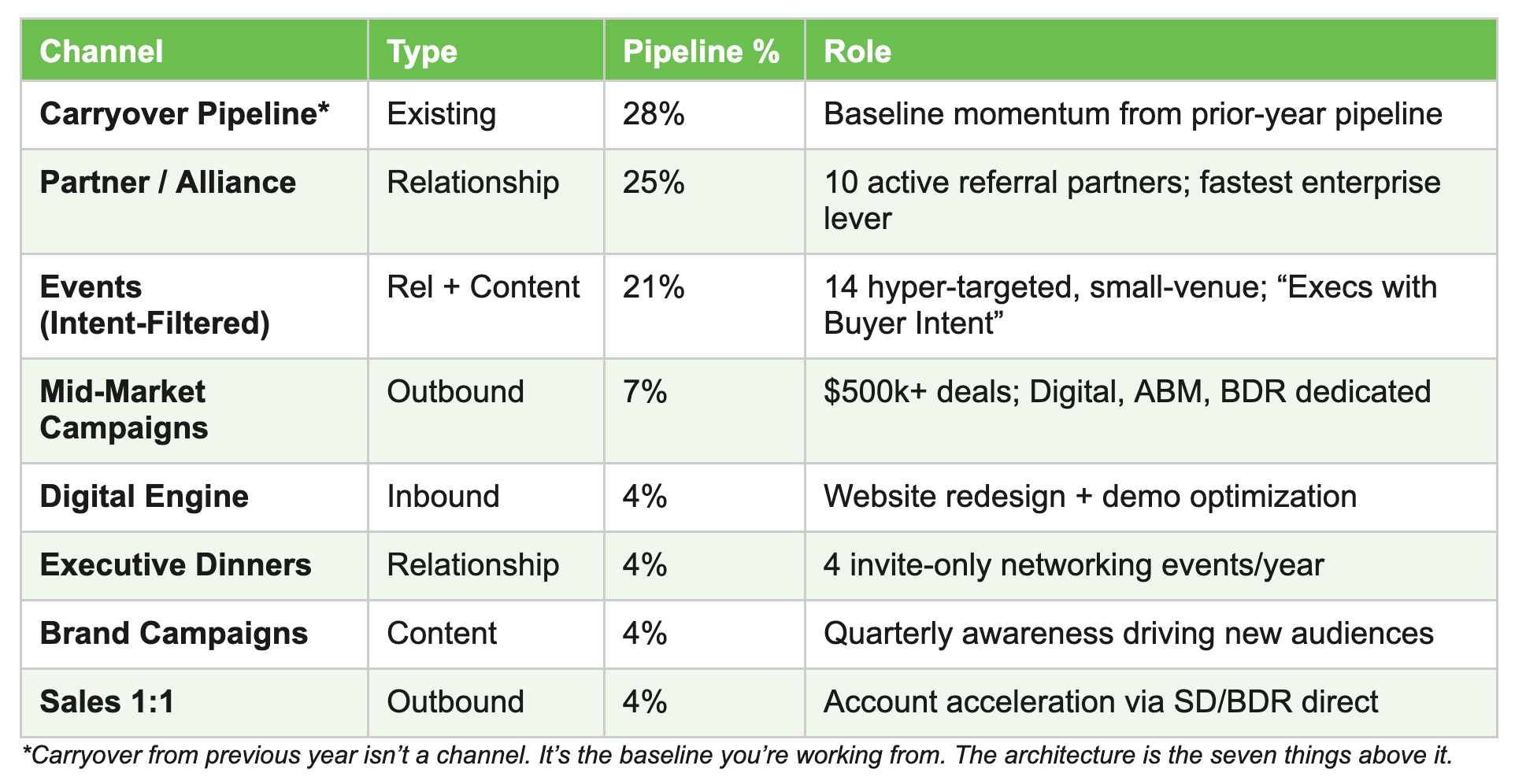
The architecture I build generally runs 8 motions, not 8 channels. I’m a certified practitioner in both Winning by Design and GTM Partners methodologies, and the distinction between channel and motion is where most implementations go wrong.
Who Are You Building Pipeline For?
Most mid-market companies are marketing to 200,000 accounts and closing 40. That’s not a targeting strategy. It’s a prayer with a spreadsheet.
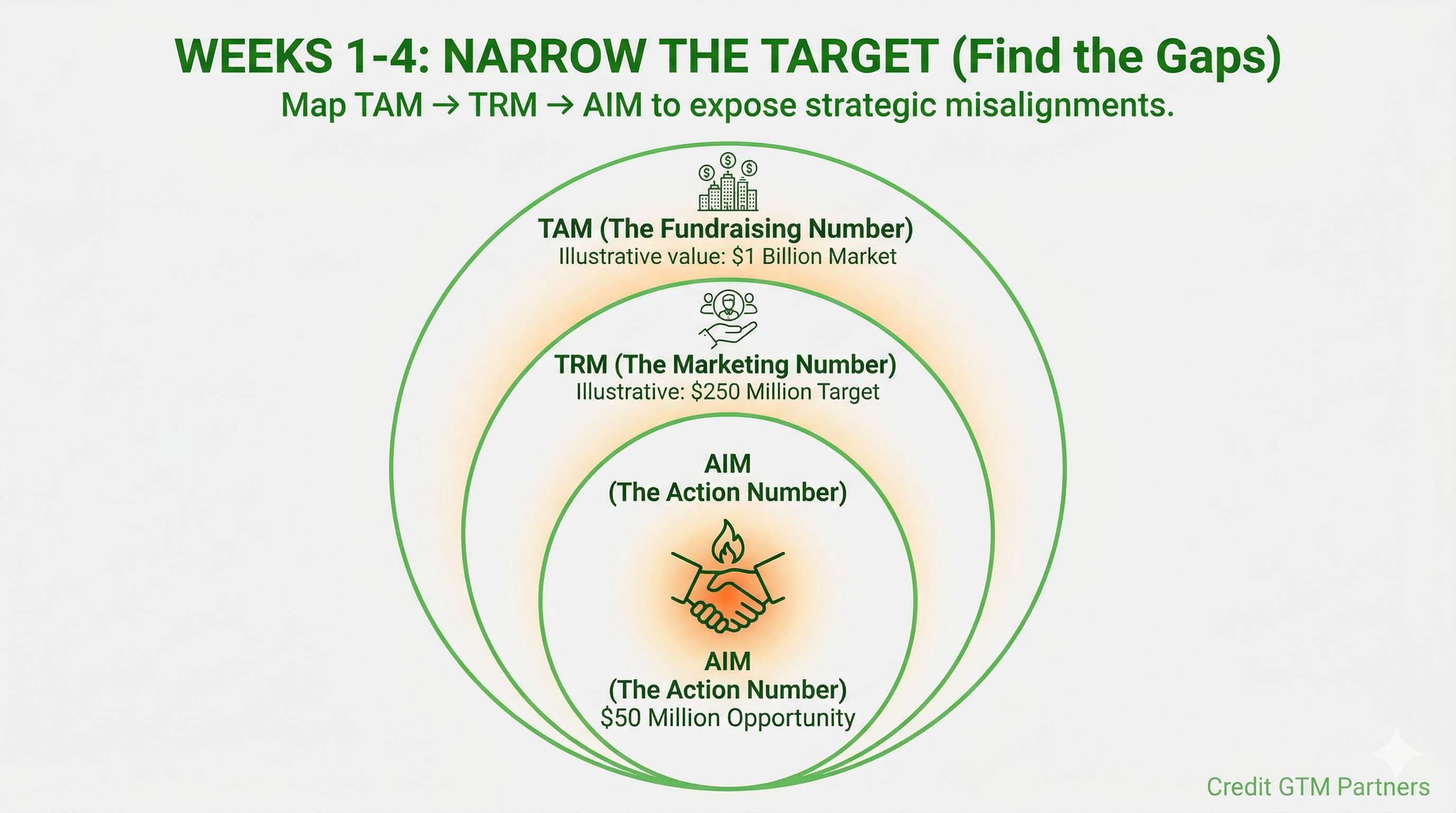
TAM (Total Addressable Market) is an investor number. Impressive on a pitch deck. Useless for demand gen. The discipline that makes channel architecture work comes from GTM Partners’ Pillar 1, and it’s simple: narrow your universe until every dollar of marketing spend is aimed at someone who might actually buy.
TAM = total market given unconstrained time and resources. The fundraising number.
TRM (Total Relevant Market) = buyers matching your ICP on firmographic, behavioral, and technographic characteristics. The targeting number.
AIM (Already In Market) = TRM accounts actively evaluating a solution like yours right now. The action number.
When you narrow TAM → TRM → AIM, the universe shrinks. Conversion rates and deal velocity improve. You’re marketing to 2,000 accounts instead of 200,000, and actually closing them.
Build your channel architecture around TRM, not TAM. Measure every channel’s effectiveness against TRM accounts reached and AIM accounts activated. (See my full TRM diagnostic framework in Essay 2: Diagnose Before You Prescribe.)
How to Evaluate Your Channels
Eight channels isn’t the right number for every company. You need to evaluate which channels are right for your situation, your market, and your buyer.
Eight is a heuristic. It’s enough to diversify, few enough to measure.
The discipline matters more than the number.
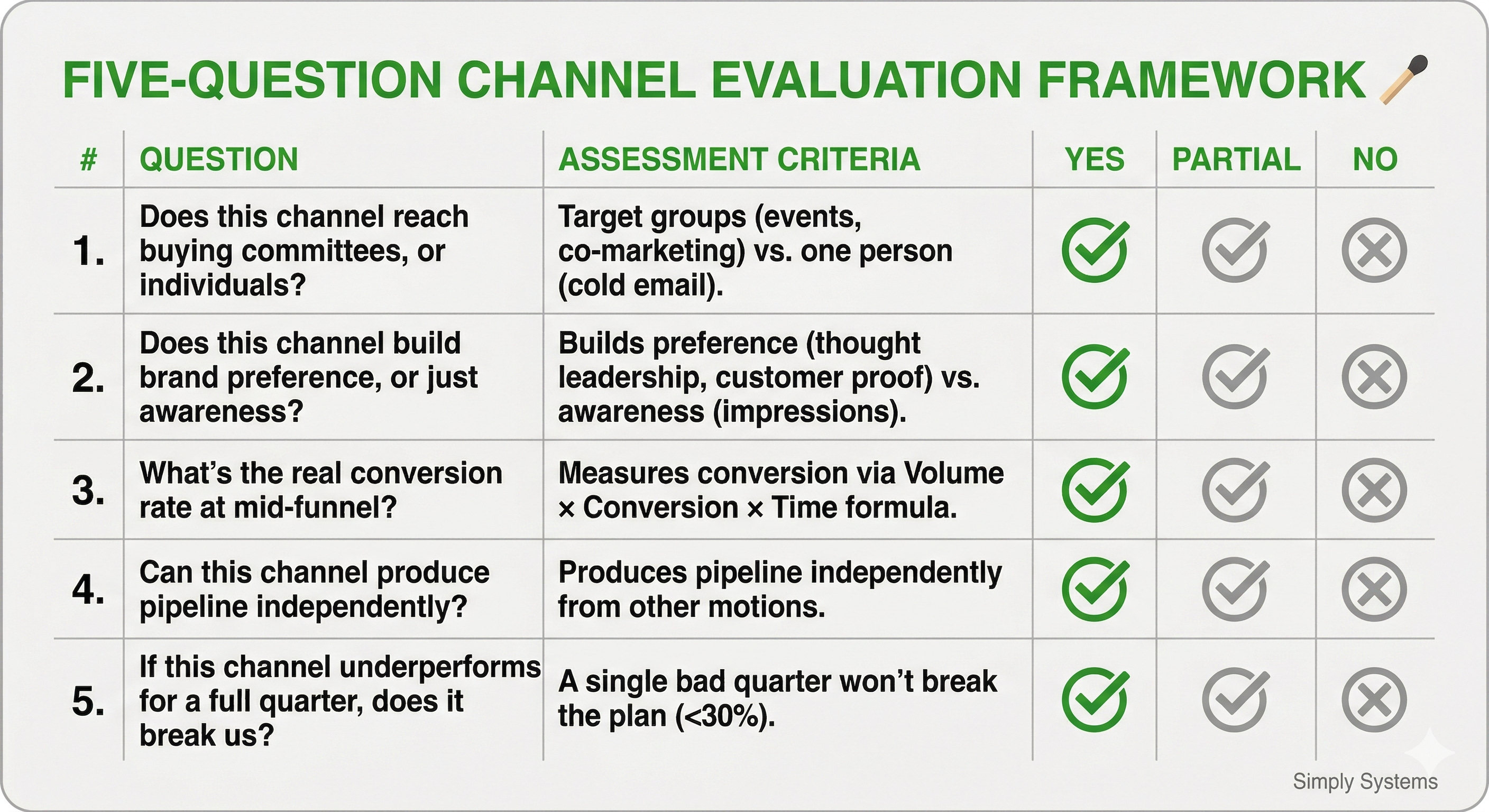
1. Does this channel reach buying committees, or individuals?
Cunningham’s data: 10.1 people per buying group, each averaging 16 interactions with the winning vendor. That’s roughly 160 touchpoints per deal. Your cold email program reaches exactly one of those people. Events, co-marketing, and executive programs reach committees. Different animals.
2. Does this channel build brand preference, or just awareness?
Awareness alone isn’t enough. Buyers pre-rank before first contact, and the vendor ranked first wins 80%+ of the time. Channels that produce preference (ie, thought leadership, customer proof, partner endorsement) do more pipeline work per dollar than channels producing impressions.
3. What’s the real conversion rate at mid-funnel?
The measurement discipline I run inside every channel architecture uses a formula from Winning by Design’s revenue architecture: Volume × Conversion × Time.
Applied at each stage of the Bow-Tie lifecycle (CR1 through CR9). Common language between marketing and sales. Not “we generated X MQLs” but “this motion produces Y pipeline at Z conversion with a Q-day cycle.”
4. Can this channel produce pipeline independently?
BDR outbound that only works when fed event leads isn’t independent. It’s a dependent motion. Count it as part of the event channel. Independent means: if every other channel stopped, this one still produces on its own.
5. If this channel underperforms for a full quarter, does it break us?
If yes, it’s too large. Architecture principle: no single channel above 30%.
When the biggest is under 30%, a bad quarter creates a gap you can manage. Doesn’t kill the company.
Five-Question Channel Evaluation Framework
How to Build the Architecture
Step 1: Categorize. Primary channels contribute >10% of pipeline each. Secondary contribute <10% but are strategically necessary—testing grounds, long-cycle investments, emerging bets.
Step 2: At least 3 primary channels. Fewer than three at >10% each = fragile pipeline. One bad quarter from a board conversation you don’t want.
Step 3: Balance across three types. Relationship channels (partner co-marketing, executive events, advisory boards, customer referrals)—highest conversion because trust is pre-built. Content/Inbound (thought leadership, digital demand gen, webinars, analyst-driven content)—builds the brand engine that makes every other channel work. Outbound/Activation (ABM-informed account plays, BDR programs, targeted campaigns)—surgical when targeting is right. Expensive when it’s not.
Step 4: Test and measure. Every new channel gets 90 days. No exceptions. No “give it two more quarters.” Hasn’t produced a qualified conversation in 90 days? Hypothesis is wrong or execution is wrong. Fix or kill.
Step 5: Operate as motions, not channels. Each channel runs as a GTM motion—cross-functional, with marketing, sales, and CS coordinating toward pipeline. Winning by Design’s SPICED framework (Situation, Pain, Impact, Critical Event, Decision) provides the common operating language. When the event team, BDR team, and partner team all use SPICED to qualify, handoff friction disappears. (Full SPICED application in “Diagnose before Your Prescribe.”)
Partners: The Highest-Trust Channel
Here’s a question I now ask before I touch a single channel: Who does your buyer already trust?
Not who has the biggest audience. Who has already earned trust with your ICP?
Partners such as technology partners, consultants, integration firms, and resellers are embedded in your buyer’s world before you arrive. A referral from a trusted partner doesn’t convert incrementally better than a cold touch. It converts at a structurally different rate.
Try this simple exercise to evaluate your partner opportunity:
Take your marketing budget and recategorize every line item under a lens called “trust development.”
Stack your thought leadership, events, customer evidence, executive visibility, and partner programs under that heading and see what the actual number is relative to your other programs. For most companies, it’s shockingly low relative to the acquisition spend it’s supposed to support. Partners are the purest expression of that trust strategy.
When buying committees use AI to research and communities to validate, vendors connected to existing ecosystems get discovered first.
A $200M company can’t compete with Salesforce on distribution.
But embedded in the technology partners and consultants Salesforce doesn’t reach, you’re playing a game they can’t.
GTM Partners’ data: 66% of surveyed companies now use Partner-Led Growth and it’s the second most common motion after outbound.
Build it simply.
Start with 10 active referral partners. Not 100. Ten.
Filter by trust: who does your ICP already hire, consult, or rely on?
Build co-marketing around shared problems, not joint logos. Every partner gets a 90-day activation window. One qualified conversation minimum. No exceptions.
In one engagement, I targeted Partner/Alliance to contribute 25% of second-half pipeline (making it the second-largest channel behind events). Ten referral partners. Simple premise: co-solve the customer’s problem, and pipeline follows.
It did.
Two Companies. Same Architecture. Same Results.
I’ve built this twice. Different industries. Different starting conditions. Same structural problem. Same fix.
Company A: Enterprise conversational AI
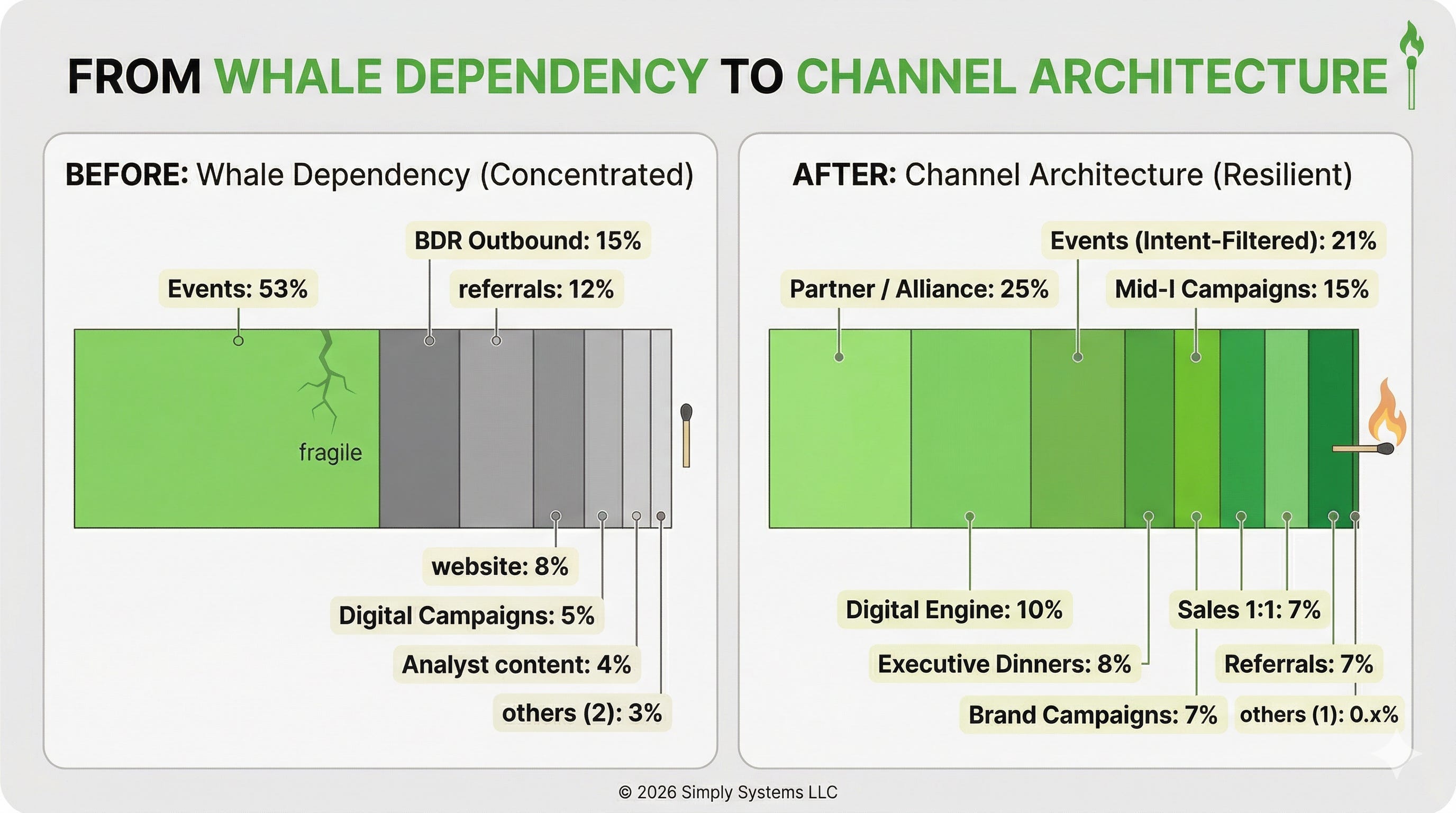
Starting condition: 53% of MOFU pipeline from Events. Website 12%. BDR 9%. Referrals 8%. Everything else under 5%.
I need to be honest about something. Events worked incredibly well.
It was Post-COVID, people were starving to meet face-to-face, and we’d gotten smart about which gatherings to attend and how to run them.
Events went from <10% to 53% in less than 1 year because we were damn good at them. We treated the channel like a digital program in terms of rigorous analytical followup. We refused to immediately pass names to the Sales team, because that’s downright lazy on our part (and what 99% of marketing depts do).
Instead, we developed each relationship. They entered the pipeline eager to participate.
That success made the next conversation harder: I had to walk into a room and argue for dismantling the most productive thing we did.
Try explaining to a Sales team that their favorite channel is a structural risk.
But 53% concentration in any single channel is a structural risk, no matter how well it performs.
One cancelled conference, one budget freeze, one quarter where the event calendar goes cold, and you’re staring at a board that wants to know why you missed by 40%.
The evolved thinking: We stopped competing at large industry conferences where we were invisible next to competitors with 50x our booth budget.
We shifted entirely to 14 hyper-targeted, small-venue events.
We took thought leadership over booth presence.
We focused on 1:1 conversations with qualified ICPs over badge scans (we prohibited scanners).
BEFORE-DURING-AFTER programming was coordinated across three teams.
Selection criteria: buyer intent and meeting guarantee, not sponsorship package.
Key principles: These principles REALLY worked for us:
“Execs with Buyer Intent” replaced vertical targeting. This greatly simplified our motions, especially with limited resources.
1:Few strategies replaced 1:Many. MOFU conversion became the North Star. We picked “quality” over “quantity.”
Results: 9x pipeline YoY in the first year of the rebuild. Third quarter showed +23–32% growth across every top-of-funnel metric. The company was later acquired.
Company B: Contact center technology, mid-market
Different industry. Smaller team. Same challenge.
When I pulled the attribution data, events were carrying the pipeline and the rest of the channels were producing dashboards, not deals. The team was good. The architecture was brittle.
I diagnosed the same concentration risk, built the same eight-channel framework, applied the same MOFU North Star. The specific channels were different—this company’s buyer lived in different rooms and responded to different signals—but the architecture was identical. No single channel above 28%. Budget split: 70% lead generation, 20% brand, 10% operational. Targets: +50% YoY pipeline meetings, +300% YoY qualified opportunities.
The specific channels were different. The architecture was identical. The results compounded.
That’s the point.
The architecture is the IP.
The channels are math.
You evaluate, test, measure, rebalance.
The system survives the specific channel choices.
AI Is a Multiplier, Not a Strategy
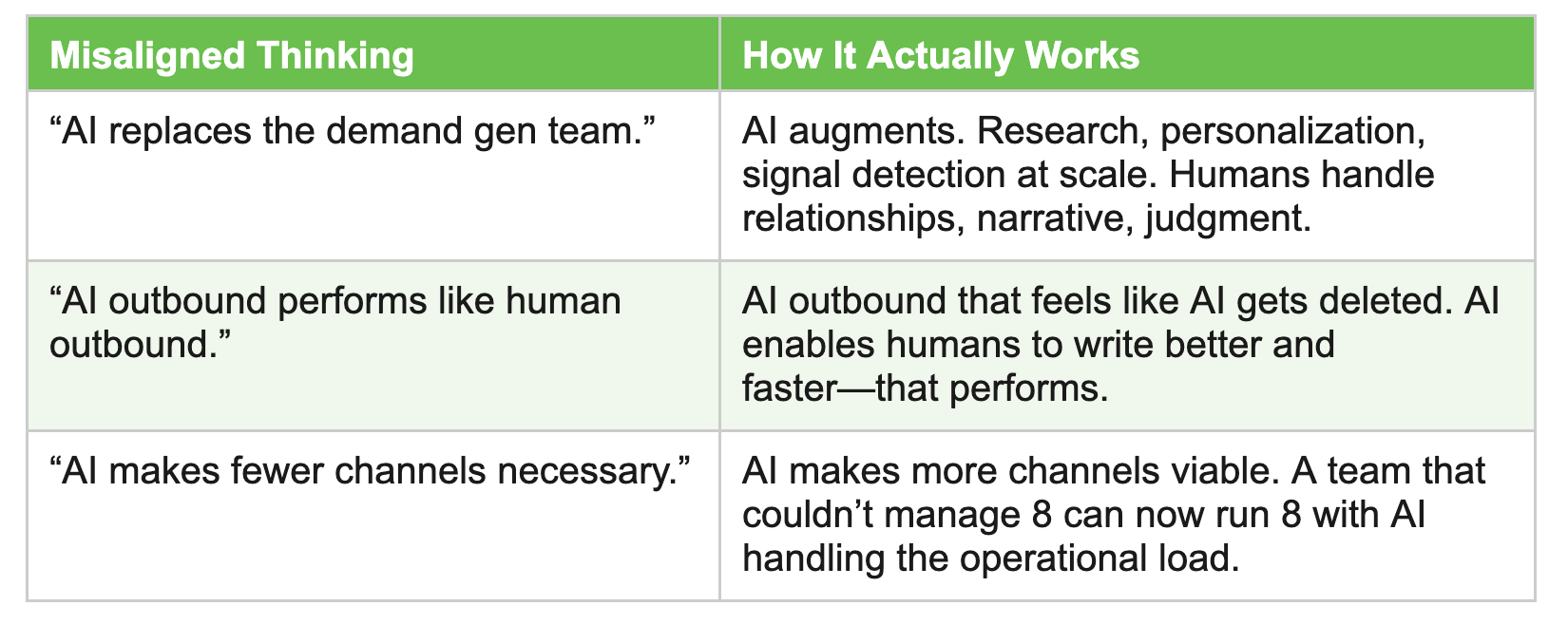
Jon Miller, godfather of ABM and Marketo founder, framed it well: if AI can handle the “-ing” in marketing, then we can focus on the “market.”
My operating principle: AI efficiency + human individuality + market differentiation + genuine connection.
AI handles the first. Humans own the rest.
I deploy AI operationally in production, across real revenue teams. The companies getting value from AI in GTM are the ones treating it as infrastructure, not strategy.
(PHM Note: Where AI agents sit in the RACI will be a future deep dive in this series — Coming soon!.)
Cunningham’s data reinforces this: 94% of buyers now use LLMs during their buying process, yet they maintain the same 16 vendor interactions per person as before AI tools became widespread.
In other words, LLMs augment research. They don’t replace the need for human trust.
The Measurement Discipline
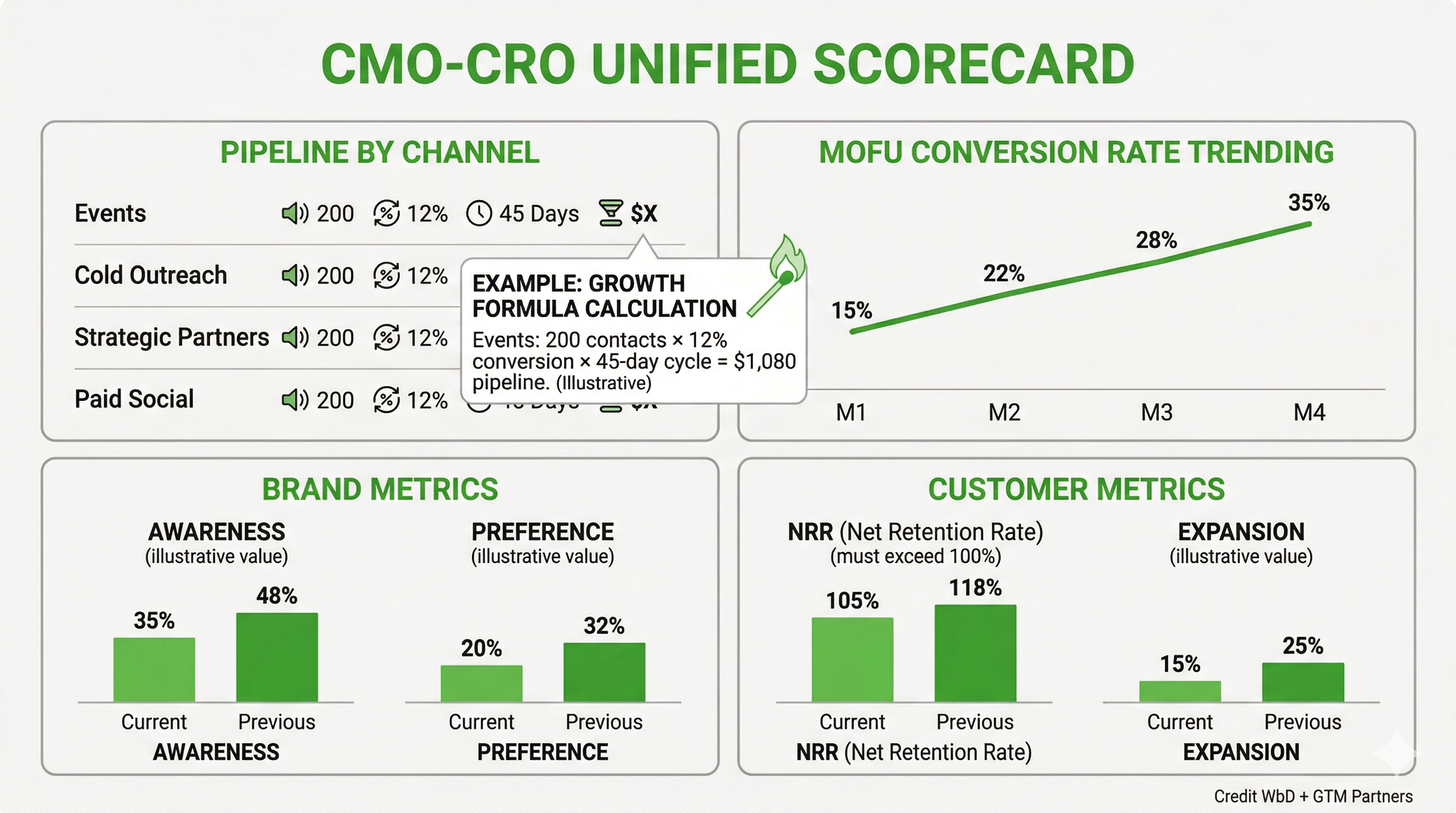
North Star: Mid-Funnel Conversion Rate
Not MQLs. Not top-of-funnel volume.
**MAKE MID-FUNNEL CONVERSION YOUR CORE METRIC.**
MOFU is the rate at which engaged prospects become qualified pipeline.
Why mid-funnel?
Marketing controls the top. Sales controls the close.
Mid-funnel is the handshake. One shared metric. One shared success.
When I walk into a company, the first thing to ask is, What actually matters?
Forget the 17 dashboards somebody else built three years ago that you now rely on because nobody has the courage to kill them. Start with what moves pipeline.
Growth Formula per Channel, per Bow-Tie Stage
Volume × Conversion × Time. Applied at each stage of Winning by Design’s Bow-Tie lifecycle (CR1 through CR9). Every channel. Every quarter. This eliminates “marketing sourced vs. sales sourced” permanently. Replace it with: “This motion produces Y pipeline at Z conversion with a Q-day cycle. Here’s how we improve each variable next quarter.”
Quarterly rebalancing
Which channels are converting above benchmark?
Double down.
Which are below, and why?
Fix the variable or kill the channel.
And the third question, which matters most: what’s the one channel we’re not running that the data says we should be?
Until you test it, the channel you haven’t tested is going to have the highest potential upside.
Build This in 90 Days
You’re the CMO who just inherited a whale-dependent pipeline. PE board wants evidence in one quarter. Here’s the sequence.
Days 1–30: Diagnose
Pipeline attribution audit. How many channels produce independently? What percentage does each carry? How many current-quarter deals exceed 15% of target?
10/10 Rule: 10 customer win interviews. 10 loss interviews. Conversations, not surveys. You’ll learn more in 20 conversations than a month of dashboards.
Growth Formula applied to every active channel. Which are volume-starved, conversion-poor, or cycle-time problems?
TRM exercise. Narrow from TAM to TRM to AIM. Define who you’re actually targeting. (Full framework in Diagnose before You Prescribe.)
Deliverable: One-page diagnostic. Three biggest opportunities. Three biggest risks.
Days 31–60: Architect
Stand up the channel framework.
Assign motion owners (needs to be cross-functional accountability, not marketing-only).
Fix the North Star: one metric, mid-funnel conversion.
Recheck the ICP, which is outdated if it’s more than 18 months old. Map the Buying Committee as it exists today, including AI Transformation stakeholders that your 2024 ICP almost certainly doesn’t account for.
Launch the fastest pipeline lever first, usually partner co-marketing or intent-filtered event activation.
Stand up 2–3 new channels simultaneously, each with 90 days and a clear contribution target.
Days 61–90: Measure and Rebalance
First pipeline review with attribution by channel.
Growth Formula calculated per motion.
Quarterly rebalancing plan drafted.
Then present to the board: here’s what we found, here’s what we built, here’s the early data, here’s where we’re investing next quarter and why.
A board that sees pipeline improving with architectural discipline in 90 days gives you runway. A board that sees theory while pipeline stays flat fires the CMO.
Build Your CMO-CRO Unified Scoreboard
This is an example only, but you get the idea:
Lock in the Discipline
It doesn’t matter if you have one channel or ten. What I care about is whether you’ve tested them honestly.
Whether you’re measuring each against the Growth Formula.
Whether you’re willing to kill the ones that don’t perform, even if the CEO’s favorite analyst recommended them.
That VC’s question was the first one I heard. It’s now the first one I ask.
“How many channels produce pipeline independently?”
If your answer is less than four, start building.
The hardest part is always the first honest assessment.
Everything after it gets a little easier. Not easy. Easier.
The architecture is how you survive.
The measurement is how you improve.
The discipline is how you win. 🚀
Peter (P.H.) Mullen is a three-time CMO and founder of Simply Systems LLC, where he builds the revenue engine for PE-backed companies between $50M–$500M. He writes The Growth Engine Playbook on Substack.